


The opening of the painting and drawing gallery in December 2009 marked the culmination of thirty-five years of passion and experience. Long known as an antique dealer specialising in furniture and objets d’art, Michel Descours had the desire and ambition to create a space in Lyon devoted exclusively to what he considered to be the best in the field of fine art. If the gallery is a reference in terms of the Lyon school (Thomas Blanchet, Louis Cretey, Jacques Stella, Hippolyte and Paul Flandrin, Louis Janmot…), its interests go far beyond this production and encompass Italian primitives as well as 19th century Nordic painting and modern art.
Ten years later, in 2019, Michel Descours moved to Paris and opened a space at 10, rue de Louvois, in the 2nd arrondissement, in the heart of the artistic capital. This is now the address of the gallery, where he continues to present a taste and an eye for all schools, while still attaching great importance to the Lyon school.
The gallery regularly collaborates with museums and offers at least one exhibition each year (thematic, monographic or period). Since 2010 it publishes a catalogue every year.
Louis CRETEY
(Lyon, 1643 — Gentilly, 1713)
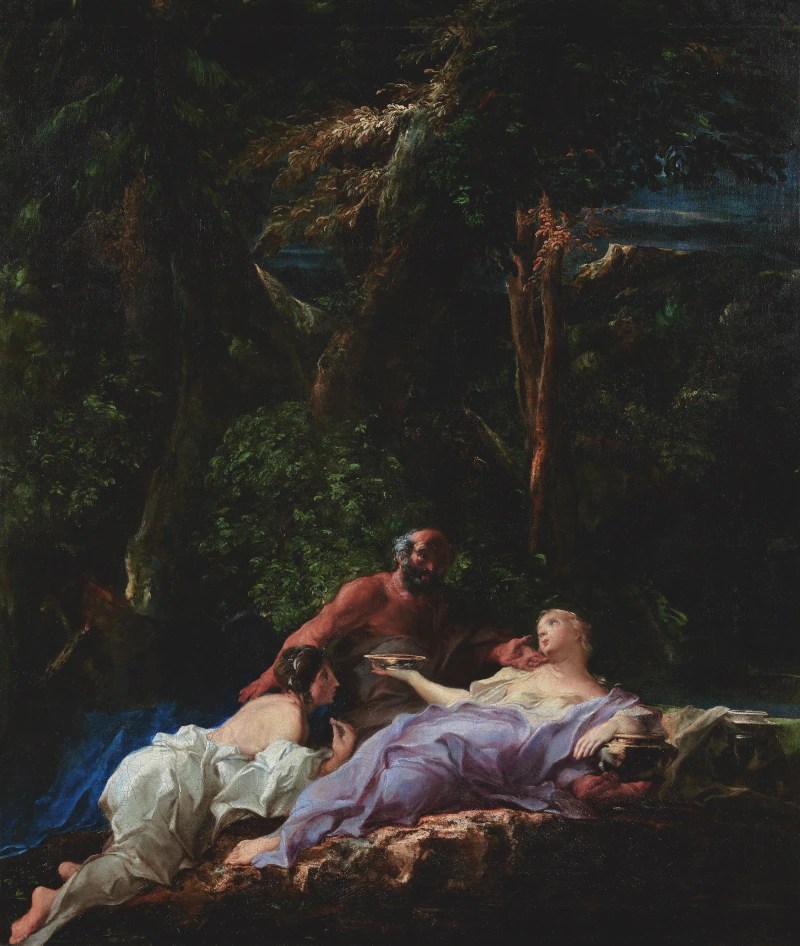
Loth et ses filles
Oil on canvas
112,5 x 96 cm
Louis Cretey, a painter active in the second half of the 17th century, has seen a resurgence of critical interest over the past decade, sparked in particular by a seminal article published in 1988 and confirmed by the publication of his catalogue raisonné in 2010, which was expanded in 2020.
Long overlooked and sometimes confused with Italian artists due to his free and expressive style, he stands out for a pictorial practice characterised by rapid execution, dynamic anatomies and a prioritisation of effect over academic rigour.
His biography, now better established, reveals a career spanning Lyon and Rome, which explains the originality of his artistic language.
The work on display, depicting Lot and his daughters, illustrates both the singularity and the evolution of his style.
It is characterised by a relative freedom from the biblical narrative, the scene being transposed into a forest landscape and devoid of any explicit reference to the destruction of Sodom. This iconographic choice, unusual for Cretey, suggests an adaptation of the subject to a decorative function, likely as part of a private commission in the late 1680s or early 1690s.
The composition, vertical and slender, gives a central role to the landscape, which structures the space and contributes to the narrative. The figures, partly based on models already used by the artist, demonstrate a re-use characteristic of his practice, whilst integrating into a renewed mise-en-scène. The treatment of chiaroscuro, the chromatic contrasts and the pyramidal balance of the bodies reflect a confident mastery of composition.
Finally, this work belongs to a phase in which Cretey gradually turned away from major institutional commissions to work for private clients. The landscape plays a central role here, creating an intimate space conducive to the staging of the biblical subject and the expressiveness of the figures, thus confirming the originality of his work within the French painting of his time.
BACK
TO THE LIST OF EXHIBITORS